Free Speech and Pluralism

Protecting free speech means protecting a free press, the democratic process, diversity of thought and beliefs, protest rights, and so much more.
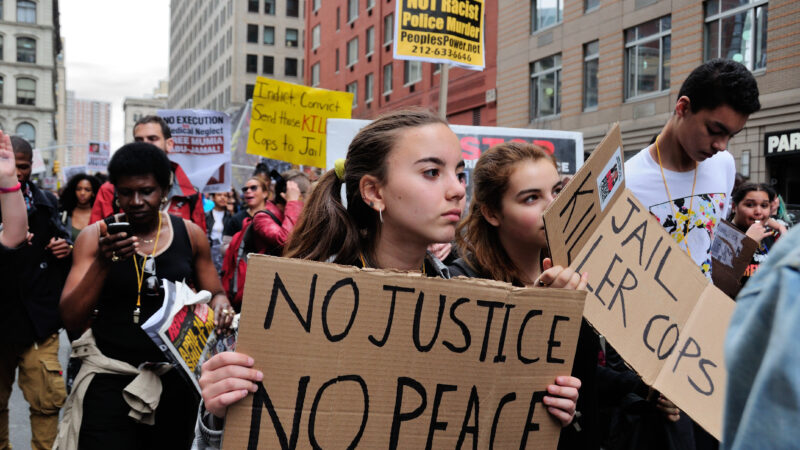
Image of protesters with no justtice no peace sign

What you need to know

1920

The ACLU has been involved in virtually all of the landmark speech cases to reach the U.S. Supreme Court since the 1920s.

1969

The year that the U.S. Supreme Court ruled that students do not “shed their constitutional rights to freedom of speech or expression at the schoolhouse gate.”

1997

When the U.S. Supreme Court agreed, in a landmark decision, with the ACLU’s argument that the Internet itself is a free-speech zone.

Since 1920, the ACLU has worked tirelessly to ensure the First Amendment is upheld for all. This includes not only the freedom of speech, but also freedom of the press, of association, of assembly and petition, and our freedom to protest: this set of guarantees, protected by the First Amendment, comprises what we refer to as freedom of expression. The Supreme Court has written that this freedom is “the matrix, the indispensable condition of nearly every other form of freedom.” Without it, other fundamental rights, like the right to vote, would wither and die. The First Amendment also contains the Establishment Clause, which prevents government-imposed religion, and the Free Exercise Clause, which guarantees the right to practice one’s faith (or lack thereof) without interference. These protections are central to ensuring that state-led efforts to infringe upon religious freedoms are not tolerated.

New technologies present new challenges to freedom of speech, as government officials and entities increasingly seek to censor content they dislike or disagree with. This viewpoint discrimination undermines the very essence of a free society. The ACLU believes in an uncensored internet, a vast free-speech zone deserving the full protection of the First Amendment, and we reject any attempts to minimize, censor, or outright prohibit Texans' right to protest and express themselves—including state policies that impose decency restrictions on online content, limit minors' access to information, or facilitate the unmasking of anonymous speakers without careful court scrutiny.

Additionally, Texas students face unprecedented attacks on their freedom to express themselves and learn. Certain state politicians and special interest groups have launched a coordinated campaign to target LGBTQIA+, BIPOC, religious minority students, as well as students who defy gender stereotypes, across the state. Students deserve a high-quality education in a welcoming environment so they can learn about themselves and the world around them. Visit the Students' Rights Hub to learn more about the rights that students have at school and how to protect them.

The Latest
Press Release
FILED graphic over Ten Commandments

Texas Families Sue to Block Law Requiring Ten Commandments in Every Public School Classroom

Know Your Rights
Crowd of people protesting family separation at the border

Protesters’ Rights

Press Release
Placeholder image

Texas Families File New Class Action Lawsuit to Stop Public School Districts Throughout Texas From Displaying the Ten Commandments

Press Release
Placeholder image

Texas Families File New Lawsuit to Stop Public School Districts From Displaying Ten Commandments

Court Case
Aug 29, 2024

GSA Network, et al. v. Morath, et al.

The American Civil Liberties Union of Texas, Transgender Law Center, and Baker McKenzie have filed a lawsuit challenging the constitutionality and lawfulness of four key provisions of Senate Bill 12, or Texas' Student Identity Censorship Law. The case was brought on behalf of the Genders and Sexualities Alliance (GSA) Network, Students Engaged in Advancing Texas (SEAT), the Texas American Federation of Teachers (Texas AFT), a teacher, and two students and their parents against Mike Morath, in an official capacity as the Commissioner of the Texas Education Agency (TEA), Houston ISD, Katy ISD, and Plano ISD. S.B. 12 bans diversity, equity, and inclusion efforts in Texas public and charter schools and prohibits teachers and student groups from discussing or supporting topics related to race, gender identity, and sexual orientation. The law eliminates programs such as cultural history events, training on inclusion, and student clubs like GSAs that provide safe and affirming spaces for LGBTQIA+ students. The law also bars school employees from “assisting” a student’s social transition, including by providing “any information” about this topic, which is unconstitutionally vague and has already resulted in transgender students being discriminated against and harmed across Texas. As this lawsuit remains pending, we urged every school district in Texas to continue following other federal and state laws that require preventing bullying and harassment of transgender students when implementing this vague and unconstitutional provision. S.B. 12 is one of the most extreme education censorship laws in the country. The law censors the speech of students, parents, educators, and others not only in classrooms, but also after-school programs, field trips, private events on school property, and informal conversations. By silencing discussions of race, gender, and sexual orientation, S.B. 12 threatens students’ safety and privacy, punishes educators for fostering inclusion, and erases the histories and identities of marginalized communities from Texas schools. The plaintiffs are nonprofit organizations, a teacher’s union, two students, and an educator directly affected by the law’s sweeping prohibitions. Together, they challenge the elimination of safe spaces and inclusive programs that make students feel like they belong in Texas schools. The lawsuit argues that S.B. 12 violates the First and Fourteenth Amendments of the U.S. Constitution and the federal Equal Access Act. Plaintiffs have filed a motion for preliminary injunction to block enforcement while the case proceeds, and a preliminary injunction hearing is scheduled for December 1, 2025. Our clients are asking the court to block four unconstitutional provisions of S.B. 12 and affirm that Texas schools should empower every student — no matter their race, gender, or background — to learn, grow, and thrive, not silence their identities or erase their histories. The lawsuit was filed in the Houston Division of the U.S. District Court for the Southern District of Texas on August 28, 2025.
Court Case
Aug 03, 2023

The Woodlands Pride, Inc. et al, v. Warren Kenneth Paxton, et al

Two LGBTQIA+ nonprofit organizations, two drag production and entertainment companies, and a drag artist are suing the State of Texas to stop state officials from implementing an unconstitutional and far-reaching drag ban.
Court Case
Oct 21, 2021

A.C. et al v. Magnolia Independent School District

Court Case
Dec 18, 2018

Pluecker v. Paxton

A lawsuit challenging a state law that requires government contractors to certify that they are not engaged in boycotts of Israel or territories controlled by Israel.