
News & Commentary
In Reversal, DOJ Poised to Give Notice of Warrantless Wiretapping
On Wednesday evening, the New York Times reported that for five years the Department of Justice had a policy that deprived criminal defendants of notice that they had been surveilled under the FISA Amendments Act (FAA) — the 2008 law that authorized the NSA's warrantless wiretapping of Americans' international communications. This policy contradicted assurances made by the government in our constitutional challenge to the FAA, that it would notify criminal defendants if it ever intended to use evidence derived from FAA surveillance against them. (The Supreme Court repeated that argument in its opinion dismissing our challenge on standing grounds.) According to the article, after the Solicitor General learned this summer of the DOJ's policy, he concluded that it "could not be legally justified" and pushed to have it reversed.
By By Patrick C. Toomey, Staff Attorney, ACLU National Security Project

This Week in Civil Liberties (10/18/2013)
What frightening powers might be conferred when organizations like the NSA have personal information on ordinary Americans?
By By Rekha Arulanantham, ACLU
Breaking the Addiction to Incarceration: Weekly Highlights
Today, the U.S. has the highest incarceration rate of any country in the world. With over 2.3 million men and women living behind bars, our imprisonment rate is the highest it's ever been in U.S. history. And yet, our criminal justice system has failed on every count: public safety, fairness and cost-effectiveness. Across the country, the criminal justice reform conversation is heating up. Each week, we feature some of the most exciting and relevant news in overincarceration discourse that we've spotted from the previous week. Check back weekly for our top picks.
By By Alex Stamm, ACLU Center for Justice
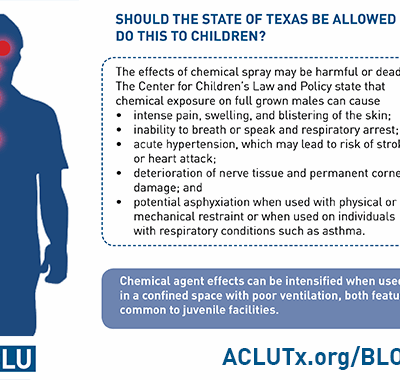
Should the State of Texas Be Allowed to Do This to Children?
A report to the Council of Juvenile Correctional Administrators found that facilities with high numbers of restraint and chemical incidents are more likely to produce higher rates of safety problems because of youth and staff injury, suicidal behavior, and fear among the youths from injury by staff.
The reported higher rate of incidents explain why the Council of Juvenile Correctional Administrators’ annual, national survey revealed only six state juvenile corrections agencies authorizing the use of chemical spray in order to secure the facilities: The low national authorization is due to data that shows negative impacts on the staff, juveniles, and facilities when it is used. The survey also showed that 15 agencies authorized chemical restraints, but not necessarily for the staff to carry on their person. Nine of those 15 agencies only authorize chemical restraint as a last
By By Samantha Penturf, Policy Intern, ACLU of Texas
No NSA Poster Child: The Real Story of 9/11 Hijacker Khalid al-Mihdhar
This story originally appeared at Defense One.
By By Mike German, ACLU, Washington Legislative Office
Cosplaying While Gay, Black, or Female at New York Comic Con
This past weekend was New York Comic Con (NYCC), and in addition to the usual comic book enthusiasts and army of animated cosplayers, there seemed to be a bit of an uprising brewing. Much to my delight, there were quite a few panels addressing the (lack of) visibility of LGBTQAI individuals, people of color, and women. Would my love of all things geek and all things ACLU finally intersect?
By By Danielle Aronson, ACLU
Creepy Government Surveillance Shouldn't Be Kept Secret
Shocking revelations about creepy government surveillance came in waves over the summer, from the Snowden leaks to the Hemisphere Project, through which the government has paid AT&T for access to a mind-bogglingly vast database of our telephone calls. In many cases of new surveillance technologies like Hemisphere, there are serious constitutional concerns that courts have not yet reviewed. That's where we come in.
By By Linda Lye, Staff Attorney, ACLU of Northern California
Should It Cost Less to Get Out of Jail if You're Rich?
Eric Amparan likes the system the way it is now. As a bail bondsman, he's part of an industry that pulls in $2 billion in revenue every year. Eric lays out how he profits off of financial desperation in our latest video in the Prison Profiteers series:
By By Jesse Lava, Campaign Director, Beyond Bars & Sarah Solon, Communications Strategist, ACLU
On the Prospect of Blackmail by the NSA
Sometimes when I hear public officials speaking out in defense of NSA spying, I can’t help thinking, even if just for a moment, “what if the NSA has something on that person and that’s why he or she is saying this?”
By By Jay Stanley, Senior Policy Analyst, ACLU Speech, Privacy & Technology Project
Stay Informed
Sign up to be the first to hear about how to take action.
By completing this form, I agree to receive occasional emails per the terms of the ACLU’s privacy statement.
By completing this form, I agree to receive occasional emails per the terms of the ACLU’s privacy statement.