
News & Commentary
Librarians (and Captain Underpants) to the Rescue!
To celebrate Banned Books Week, this year I sat down with three librarians to peek behind the curtain and examine the ways by which library books are chosen and challenged; I also wanted to get the inside scoop on what the future of the library looks like. This first installment of the two-part series features two local school librarians in Houston. Much like the superheroes they are, the two preferred to keep their true identities concealed, so I will be referring to them as “Barbara Gordon” and “Judy Dark," which happen to be the librarian alter-egos of the superheroes "Oracle" and "Luna Moth" (our apologies to D.C. Comics and Michael Chabon). Our next installment will feature my conversation with Peter Coyl, District Manager of the Dallas Public Library.
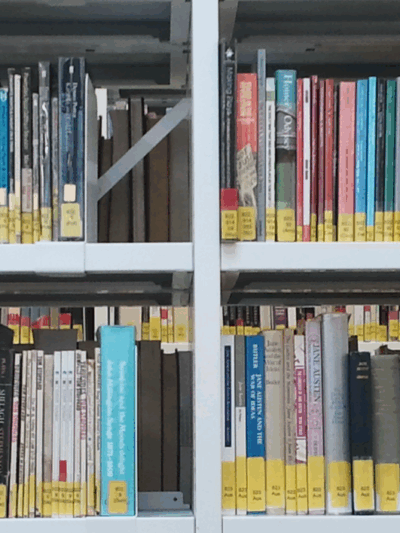
Banning Books in Texas
Some residents in Granbury, Texas, are lobbying to remove Princess Boy and This Day in June from the Hood County Library because they “indoctrinate children to the LGBT lifestyle” and “promote perversion." Hood County Library Director Courtney Kincaid decided to keep the books on the shelves, but next week the commissioners’ court will meet to discuss whether or not to reverse her decision. Book banning is one of the worst crimes one can commit against the human intellect, and undermines the free exchange of ideas that is one of the pillars of our democracy. We’ll be keeping a close eye on the commissioners’ court’s deliberations, but in the meantime, we thought we’d take a quick look at other books that have been either banned or challenged in Texas.
By Theanne Liu

How Soon Should Police Turn Off Their Cameras After a Critical Incident?
In January a Black man with his hands up was shot to death by a police officer in New Jersey. Video (and audio) of the incident was captured by the officer's dashcam. The incident didn't receive the attention of the Walter Scott video released Tuesday, probably because it seemed to many to be less clear-cut, and because it lacked a dimension of race-based abuse since the shooting officer was also Black.
By By Jay Stanley, Senior Policy Analyst, ACLU Speech, Privacy & Technology Project
Police Chief: Surveillance Cameras Don’t Help Fight Crime
Last month, the police chief of Lincoln, Nebraska announced that the security cameras watching over the city’s downtown bar scene have not proven effective in his department’s efforts to stem criminal activity. Police Chief Jim Peschong said that the recordings hadn’t helped investigators either identify new suspects or bolster evidence against current ones. Peschong also stated that the cameras hadn’t lowered crime in their vicinity: according to Lincoln Police statistics, there were 128 assaults within 500 feet of the cameras last year, numbers that are on par with the department’s five-year average.
By By Sonia Roubini, ACLU Speech, Privacy, and Technology Project
Why the War on Drugs is So Bad For Privacy
In 2011, for the 50th anniversary of Richard Nixon's declaration of America's "War on Drugs," I wrote a roundup of some of the ways in which the War on Drugs has eroded privacy. Yesterday's news about the DEA's enormous program to collect Americans' call records is a hell of an addition to the list. But with the DEA story fresh in the headlines, it's important to remember a key point about why the drug war has been so corrosive of privacy: drug use is a victimless crime.
By By Jay Stanley, Senior Policy Analyst, ACLU Speech, Privacy & Technology Project
NYCLU-Obtained Documents Reveal Secrecy, Lack of Court Oversight in Use of Invasive Stingray Technology
Last June, the New York Civil Liberties Union asked the Erie County Sheriff's Office to release information to the public about how it uses stingrays, which are used to track and record New Yorkers’ locations via their cell phones, and can collect information on all cell phones in a given area as well as track and locate particular phones. The Sheriff's Office refused, so in November we sued. Last month, a New York state Supreme Court Justice ruled in our favor, telling the Sheriff’s Office that it had to hand these documents over.
By By Mariko Hirose, Staff Attorney, NYCLU
The Internet of Kafkaesque Things
Last week I wrote about how the Internet of Things will provide an opportunity for various bureaucracies (corporate and governmental) to inject not only their information-gathering functions but also their rule-imposing functions ever more deeply into the technologies that surround us, and thus into our daily lives. In short, violating our privacy and increasing their control. But the situation is actually even scarier than that, because buried within the activity of "rule imposing" lies another function that is inherently a part of that: "judgment making." And a whole lot more trouble lies there.
By By Jay Stanley, Senior Policy Analyst, ACLU Speech, Privacy & Technology Project
DHS Wants Contract for Access to Database of Innocent Drivers’ Locations
The Department of Homeland Security’s effort to get its hands on information about the road travels of all Americans is back. In a Privacy Impact Assessment (PIA) issued yesterday about a plan for using license plate reader data, Immigration and Customs Enforcement describes a plan to “procure the services of a commercial vendor of LPR information.” The agency pays lip service to public concerns about license plate readers and offers some improvements to the government’s current more or less unrestrained use of location tracking technology. It does not, however, remedy the fundamental civil liberties problems with such a project.
By By Bennett Stein, ACLU Speech, Privacy and Technology Project
Stay Informed
Sign up to be the first to hear about how to take action.
By completing this form, I agree to receive occasional emails per the terms of the ACLU’s privacy statement.
By completing this form, I agree to receive occasional emails per the terms of the ACLU’s privacy statement.