Media Contact

Imelda Mejia, ACLU of Texas, 346-299-6803, [email protected]

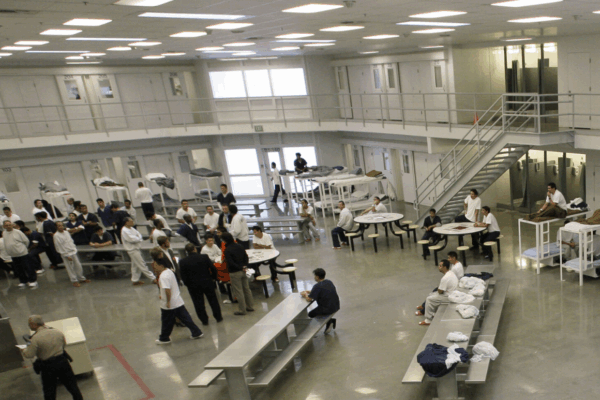
HOUSTON – The ACLU of Texas and a coalition of civil rights leaders today sent almost 500 letters to criminal justice officials urging them to take public health experts’ advice and release individuals who are at high risk of severe illness or death from COVID-19 from county jails. Specifically, the focus is placed on communities in jails with populations identified by the Center for Disease Control and Prevention as vulnerable, as well as people currently in pretrial detention.

“More than 60,000 people will sleep in jail cells in Texas tonight. Many of them have not been found guilty and are only there because they can’t pay cash bail,” said Sarah Labowitz, policy director for the ACLU of Texas. “Health experts agree that reducing incarcerated populations and protecting vulnerable groups is part of a smart response to the COVID-19 pandemic. We’re calling on criminal justice officials to do their part to prevent a public health crisis in jails and prisons.”

In the letter, the groups are calling on:

  • Police departments and other arresting agencies to stop arresting people for minor offenses. Arresting agencies can also issue citations or desk-tickets in lieu of arrest so that people can return home, balancing the need for arrest with the overwhelming public safety concerns presented by coronavirus.
  • Prosecutors to avoid cash bail requests and move for release in all but the very few cases where pretrial detention is absolutely the least restrictive means necessary to ensure public safety. They should also institute a review-and-release protocol in cases in which bail was already sought in the past 30 days and the person is currently detained.
  • Judges to minimize nonessential contact within the criminal legal system, and consider granting pretrial release to detainees in all but the very few cases where detention is the least restrictive means necessary to ensure community safety.
  • Sheriffs to ensure that jail facilities are as empty, safe, and clean as possible and that hygiene products are free and readily available to incarcerated people and staff. Sheriffs should recommend release for all people for all people whose release would not create a serious threat to public safety.
  • Community Supervision Officers to consider exercising their authority to limit the number of people who are incarcerated or who are forced to leave their homes. They should suspend supervision conditions that impede a person’s ability to seek medical care or support loved ones who may have COVID-19 and suspend detainers and incarceration for technical rule violations.

Public health experts and groups such as the National Commission on Correctional Health Care agree that incarcerated people are at high risk for infection by SARS-CoV-2 and COVID-19. By following the recommendations outlined in the letter, civil rights leaders believe state and local officials can help stem the spread of the virus in vulnerable communities and the public at large.

The letter was signed by the ACLU of Texas, the Afiya Center, Alliance for Safety and Justice, Faith in Texas, Grassroots Leadership, Next Generation Action Network, Restoring Justice, Texas Advocates for Justice, Texas Appleseed, Texas Civil Rights Project, Texas Criminal Justice Coalition, Texas Equal Access Fund, Texas Fair Defense Project, Texas Jail Project, UT Austin Senior Lecturer Michele Deitc, and the Workers Defense Project.

Related Content
News & Commentary
Jul 31, 2020
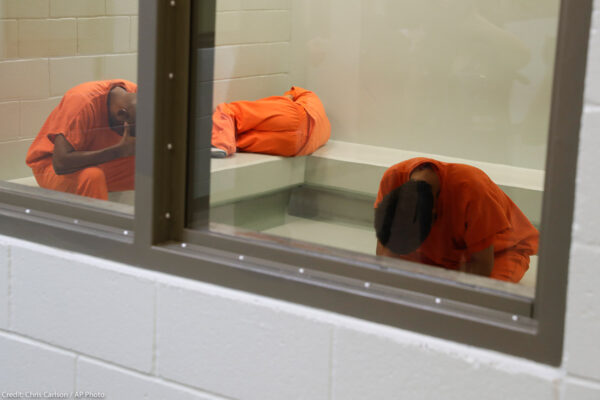
Three detainees waiting together inside a room to be processed at a detention facility.
  • Justice System and Carceral Reform|
  • +1 Issue

Prosecutors Disappoint During the Pandemic — 3rd Edition
As the COVID-19 pandemic threatens to become a death sentence for people trapped in prisons and jails across the U.S., the actions — or inaction — of prosecutors to decarcerate have had a tangible life or death impact. We examined the responses from prosecutors in the 15 biggest cities in this country. This is the third and final post in the series — you can also read the first and second.11. Austin, Texas Austin’s Margaret Moore understood the need to respond to the pandemic’s threat to people living and working in local jails. She played a significant role in bringing judges to the table to proactively work to save lives during COVID-19. The judges decided to grant no-cost bonds whenever practical to clear jail space, resulting in a dip in the jail population. As of May 12, Travis County’s adult jail system held about 1,600 people and had no positive test results. But test accessibility is distressingly low — only about 1 percent of the county’s average jail population was tested during the pandemic.Unfortunately, Moore otherwise had an unclear role in Travis County’s pandemic decarceration efforts — unlike prosecutors across the country declining to prosecute various offenses, identifying people to be released from jail, and fighting back against short-sighted restrictions by the Texas governor’s executive order limiting pretrial releases. By mid-March, her re-election opponent, Jose Garza, publicly called upon her and other city officials to do more to decarcerate jails and prisons, thereby removing hotbeds for the spread of the disease. In mid-July, voters weighed in on her limited action, choosing Garza as the Democratic candidate for November’s prosecutor election. 12. Jacksonville, Florida Jacksonville’s Melissa Nelson took early, swift action to save lives facing the pandemic in local jails. By late March, she made a temporary plan to release a significant number of people, directing her office to offer plea deals that avoid jail time, release some people pre-trial, not filing charges in non-violent “marginal” cases, and determining whether a time-served and/or probationary sentence is appropriate in any nonviolent case where the state is currently offering one year of jail time or less. The result of these policies: By late April, the number of people held in the Duval County jails fell by 21 percent. These are positive outcomes, but Nelson’s policies still fall short of helping everyone potentially vulnerable to the virus by unilaterally choosing not to consider those accused or convicted of violent or sexual offenses, rather than reviewing their circumstances before making a decision.13. Fort Worth, Texas Fort Worth’s Sharen Wilson has been extraordinarily silent as the pandemic sweeps across the country, despite the deathly threat it poses to those trapped in jails and prisons. But Tarrant County judges and sheriffs picked up her slack, holding court proceedings to grant bonds or shorten sentence lengths so people could get released sooner. Unfortunately, Wilson seems to have continued business as usual — including seeking enhancements against people for low-level offenses, such as trespassing, failing to acknowledge that forcing people to spend more time behind bars during a pandemic could have fatal consequences. 14. Columbus, Ohio In Columbus, Ohio, two prosecutors share responsibility for the city’s criminal system — Franklin County Prosecutor Ron O’Brien handles felony cases, while Columbus City Prosecutor Zach Klein has jurisdiction over misdemeanors. Both made small steps towards helping people behind bars as the coronavirus spread throughout the country, but fell short of making the deep changes necessary to save lives.In late March, Klein announced that his office was already working on criminal justice reform that would “jail only those that need to be locked up,” without providing any details on who that would include. He also expressed concern about crafting blanket policies for release. Instead, jail drops between the start of the pandemic and March 24 largely flowed from sheriffs using alternatives to arrest more often to avoid bringing people to jail.O’Brien has taken a few steps in the right direction, including limited court proceedings and only pursuing new, serious felonies. However, he did not proactively review cases involving people serving their sentences. Moreover, O’Brien expressed concern about not being more involved in court decisions to release eight youths from a juvenile detention center where the outbreak struck nearly half of the incarcerated youth and about a quarter of the staff. These small gestures toward release simply do not go far enough.15. Charlotte, North Carolina Charlotte’s Spencer Merriweather quickly worked to change his pretrial policies in response to COVID-19. At the beginning of the pandemic, his office released a statement saying they have and will continue to work diligently to ensure that the only people in pretrial custody during this crisis are the people he believes pose a risk to public safety. Merriweather claims the initiatives launched by his office to limit pretrial custody of people accused of nonviolent offenses have reduced incarceration by 14 percent since the start of the pandemic. Although he has shown flexibility on pretrial policies, Merriweather has not focused at all on those already serving sentences, even as nearby prosecutors do. Decarcerate Mecklenburg, a coalition of community activists, attorneys, and religious leaders, held rolling protests in vehicles circling Mecklenburg County Detention Center, the District Attorney’s Office, and Charlotte-Mecklenburg Police headquarters, demanding in part that Merriweather release people held on bond along with those with six months or less on their sentence, pregnant women, and everyone over 50 years of age. Without action for those vulnerable but already serving time, Merriweather is leaving hundreds if not thousands of people behind bars to face a deadly virus. In fact, in late July, more than 40 people at the Mecklenburg County Detention Center have tested positive for Coronavirus.The Takeaway When advocates began in early March to ring the alarm that people living and working in jails and prisons were particularly vulnerable to contracting the coronavirus, criminal system stakeholders sluggishly responded. Then it hit — prompting police, sheriffs, public defenders, judges, corrections officials, and government actors alike to work together to begin slowing the number of people coming into the system and releasing people who were especially vulnerable.Many prosecutors stepped up — this analysis, though specifically focused on the largest 15 cities in the United States, shows that. But, as the most powerful figure in the criminal legal system, prosecutors can and must do more. As COVID-19 continues to spread through jails and prisons, prosecutors must expand their initial efforts — expand the kinds of cases they outright dismiss, recommend more releases before trial, divert people into programs that will help them avoid being trapped in these facilities, recommend alternatives to incarceration after conviction whenever possible, and proactively support the release of particularly vulnerable people from both jails and prisons.The reality is that prosecutors were — and still are — in an ideal position to prevent COVID-19 from turning into a death sentence for people behind bars. Now, it’s time for them to act. 
News & Commentary
Jul 29, 2020
A gavel rests on the judge’s bench in a courtroom with American flag in the background.
  • Justice System and Carceral Reform|
  • +1 Issue

Prosecutors Disappoint During the Pandemic

Nicole Zayas Fortier, Policy Counsel, ACLU Campaign for Smart Justice
News & Commentary
Mar 20, 2020
Covid 19 pre-trial release
  • Justice System and Carceral Reform|
  • +1 Issue

There is an Urgent Threat Looming in Texas’ Jails. And We Can Fix it.

This is a piece about the more than 60,000 people in jails across Texas, the people who work inside the jails as well as courtrooms and police stations, and what we can do to save lives in our community.