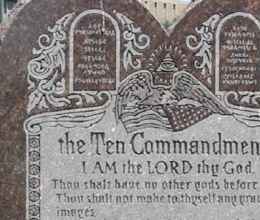
SAN ANTONIO — A group of 18 multifaith and nonreligious Texas families filed a class action lawsuit today to stop all Texas public school districts that are not already involved in active litigation or subject to an injunction from displaying the Ten Commandments in every classroom. Even though two federal judges in Texas have ruled that Senate Bill 10 is unconstitutional, school districts across the state continue to display the Ten Commandments. With more than 1,000 school districts in Texas, a class action lawsuit is the most effective way to protect the religious freedom of all Texas public school children and their families.
Ashby v. Schertz-Cibolo-Universal ISD is the first class action lawsuit and the third lawsuit challenging S.B. 10 filed by the American Civil Liberties Union of Texas, the ACLU, Americans United for Separation of Church and State, and the Freedom From Religion Foundation, with Simpson Thacher & Bartlett LLP serving as pro bono counsel. In all three cases, the organizations represent Texas families who don’t want their children to be forced to observe and venerate a state-mandated version of the Ten Commandments each school day, in violation of their religious freedom.
The new Ashby v. Schertz-Cibolo-Universal ISD case is necessary because — even with two federal court injunctions preventing more than two dozen Texas school districts from displaying the Ten Commandments — public school districts continue to violate the constitutional rights of students and their families. The class action lawsuit seeks a temporary restraining order and preliminary injunction that would stop any public school district not already involved in litigation from displaying the Ten Commandments.
The plaintiff families, which represent a range of faiths and nonreligious backgrounds, attend 16 school districts not named in the previous two cases. The school districts named as defendants include: Argyle, Birdville, Carroll, Clear Creek, Deer Park, Fort Sam Houston, Hurst-Euless-Bedford, Katy, Liberty Hill, Magnolia, Medina Valley, Pearland, Prosper, Richardson, Schertz-Cibolo-Universal City, and Wylie ISDs. These districts span the Austin, Dallas-Fort Worth, Houston, and San Antonio metropolitan areas.
Quotes from the plaintiffs
“As a Jewish, Christian, and Chinese American family, we teach our children to draw strength from many traditions — not to see one as supreme,” said plaintiff Mari Gottlieb (she/her), whose children attend schools in Carroll ISD. “Forcing the Ten Commandments on my kids is indoctrination, undermines my right to guide their beliefs, and perpetuates the feelings of exclusion that our ancestors knew all too well.”
“As Unitarian Universalists, our faith is led by equity, compassion, and acceptance of all people,” said plaintiff Caitlyn Besser (she/her), whose children attend school in Hurst-Euless-Bedford ISD. “The Ten Commandments posters required by S.B. 10 impose a specific religious doctrine on my children, which directly violates our family’s faith.”
“The posters convey to my children, who are already told they are ‘not real Christians’ because they are Mormon, that they are outsiders in their school community,” said plaintiff Briana Pascual-Clement (she/her), whose children attend schools in Prosper ISD. “I never want my kids or anyone else’s kids to be attacked for what they do or do not believe.”
“I send my child to public school because I do not want the government to push religious beliefs and doctrine on my child,” said plaintiff Kasey Malone (she/her), whose child attends school in Katy ISD. “Yet the government is doing just that by elevating Christianity over my child’s nonreligious beliefs.”
Quotes from the legal team
“The courts are clear that forcing displays of the Ten Commandments on Texas students is unconstitutional,” said Chloe Kempf (she/her), attorney at the ACLU of Texas. “Yet Texas school districts won’t stop. Enough is enough. With this class action lawsuit, Texans are coming together to say: Students and families — not the government — should decide how or whether they practice their faith.”
“Politicians in Texas should know by now that public schools aren’t Sunday schools,” said Daniel Mach (he/him), director of the ACLU Program on Freedom of Religion and Belief. “Religious liberty belongs to all public school students and families, not just those who embrace some government officials’ preferred scripture.”
“Politicians are abusing their power to advance a religious extremist agenda and impose one narrow set of religious beliefs on Texas school children. Not on our watch,” said Rachel Laser (she/her), president and CEO of Americans United for Separation of Church and State. “Our Constitution’s guarantee of church-state separation means that families – not politicians – get to decide if, when, and how their children engage with religion.”
“It’s imperative to protect a captive audience of public school students, including impressionable children as young as kindergartners, from this zealous crusade to turn schools into places of religious indoctrination,” said Annie Laurie Gaylor (she/her), co-president of the Freedom From Religion Foundation. “The diversity reflected by the number of religious and nonreligious plaintiffs reveals what a distressing violation of conscience this unconstitutional law is.”
“This case is critical to reaffirm a bedrock constitutional principle: Public schools cannot be used to advance or endorse any faith,” said Jon Youngwood (he/him), global co-chair of the Litigation Department at Simpson Thacher. “Families — not the government — must have the freedom to decide how and when their children engage with religion.”
Ashby v. Schertz-Cibolo-Universal ISD is filed in the U.S. District Court for the Western District of Texas.
Litigation history
The organizations filed their first lawsuit, Rabbi Nathan v. Alamo Heights Independent School District, challenging S.B. 10 in July 2025 on behalf of 16 multifaith and nonreligious Texas families. U.S. District Judge Fred Biery issued a preliminary injunction in August preventing the 11 defendant school districts from displaying the Ten Commandments.
Despite the court’s ruling that the displays would be “plainly unconstitutional,” some Texas school districts that weren’t defendants in the Nathan case began to display or announced their intention to begin displaying Ten Commandments posters. In response, the organizations filed a second lawsuit, Cribbs Ringer v. Comal Independent School District, on behalf of a new group of 15 multifaith and nonreligious Texas families who attend 14 of these districts. U.S. District Judge Orlando L. Garcia on Nov. 18, 2025, issued a preliminary injunction requiring those districts to remove the displays by Dec. 1, 2025, and prohibiting them from posting new displays. Throughout this ongoing litigation, Texas Attorney General Ken Paxton has issued statements instructing school districts to comply with S.B. 10 unless a court has ordered them not to do so, and Paxton has sued three school districts to enforce the law.
The defendants in the Nathan case have appealed that decision and the full U.S. Court of Appeals for the 5th Circuit has agreed to hear the case (along with a case challenging a similar law in Louisiana) en banc on Jan. 20, 2026. The court injunctions blocking the schools from displaying the Ten Commandments remain in place while the appeal is pending.