
News & Commentary
Question: Will the new Standards Protect Inmates from Sexual Abuse in Texas Prisons? Answer: Yes, No, and Maybe
By Kate Vickery
Legislative Intern
On June 20, 2012, the Department of Justice (DOJ) issued its final ruling on national standards to prevent detect, and respond to prison rape, as required by the Prison Rape Elimination Act (PREA), passed in 2003.
If fully implemented, the new regulations will ensure an unprecedented level of protection for prisoners against the epidemic of sexual violence in prison, where one in ten inmates experience at least one incident of sexual victimization. The rate of abuse is significantly higher for women (13%), homosexual males (39%), and homosexual or bisexual females (18%). Unsurprisingly, inmates who are victims of sexual assault are more likely to contract HIV and suffer psychological repercussions.
The new PREA Standards apply to various degrees to state and local prisons/jails, lockups, community confinement facilities, and juvenile facilities.
The standards are over two years behind schedule; the National Prison Rape Elimination Commission presented its draft standards in June of 2009, and the Attorney General was expected to release the final language within a year. The draft standards covered everything from prison layout and construction to immigration detention centers. While the final language was hammered out, with significant public and advocate input, state agencies waited on pins and needles. Brandon Wood of the Texas Commission on Jail Standards said the standards were like the “800 pound gorilla” for many years – no one knew how much change the new rules would require for existing prisons and jails.
Texas has already put a few systems in place to help address the chronic sexual abuse in Texas prisons. In 2007, the 80th Legislature created the PREA Ombudsman program, a semi-external agency (the Ombudsman reports to the Board of Directors, rather than to the Director of TDCJ) that monitors the agency’s efforts to eliminate sexual assaults in TDCJ correctional facilities, ensure the agency's policies and procedures are in compliance with federal and state laws and standards, and respond to public inquiries. The Ombudsman office has a staff of three, who process inmates’ complaints of sexual assault, investigate the allegations, and pass all of them on to the Office of the Inspector General for further investigation.
This system is certainly a step in the right direction, but it is reactive rather than proactive. The new PREA Standards, if fully implemented by TDCJ, should result in fewer instances of sexual abuse in the first place.
The final rules are more watered down than the draft rules, but there are bright spots, particularly for the protections provided to women, youth and LGBTI inmates. As you might expect, the DOJ “has aimed to craft standards that will yield the maximum desired effect while minimizing the financial impact on jurisdictions.” In other words, there is a lot of “should be” and “do your best” language in the final rules, and the enforcement mechanisms lack bite.
Here are a few highlights:
By admin

The Horrors of Solitary Confinement: Words from Death Row Exonoree Anthony Graves
Putting inmates in solitary confinement is exorbitantly expensive and it jeopardizes public safety. Beyond that, placing a human being in solitary confinement is inhumane. But, don’t just take our word for it. Instead, you can hear it first hand from death row exonoree Anthony Graves. Mr. Graves was wrongfully convicted of murder and had been imprisoned for more than 18 years before he was exonerated. Last week was the first-ever Congressional hearing on solitary confinement and Graves bravely testified about his experience as a death row inmate in Texas. Here are just a few things he had to say:
By admin

Travis County Should End Compliance With ICE’s “Secure Communities” Program
By D
By admin
Christian Broadcasting Network highlights problems with the for-profit prison model
By F
By admin
Over-incarceration nation, and Texas is leading the pack.
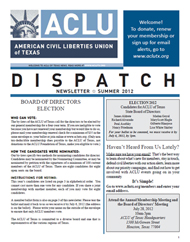
Read the Summer 2012 ACLU of Texas Newsletter ⇑
Take the quiz to test your knowledge. Then, as you go through the answers, find out what the ACLU of Texas is doing to lower incarceration rates in our great state.
1. The United States has about 5% of the world's population and holds what percentage of the world's prisoners?
a.10%
b.15%
c.25%-That's right. The "land of the free" has the highest incarceration rate in the world.
By admin
Stay Informed
Sign up to be the first to hear about how to take action.
By completing this form, I agree to receive occasional emails per the terms of the ACLU’s privacy statement.
By completing this form, I agree to receive occasional emails per the terms of the ACLU’s privacy statement.